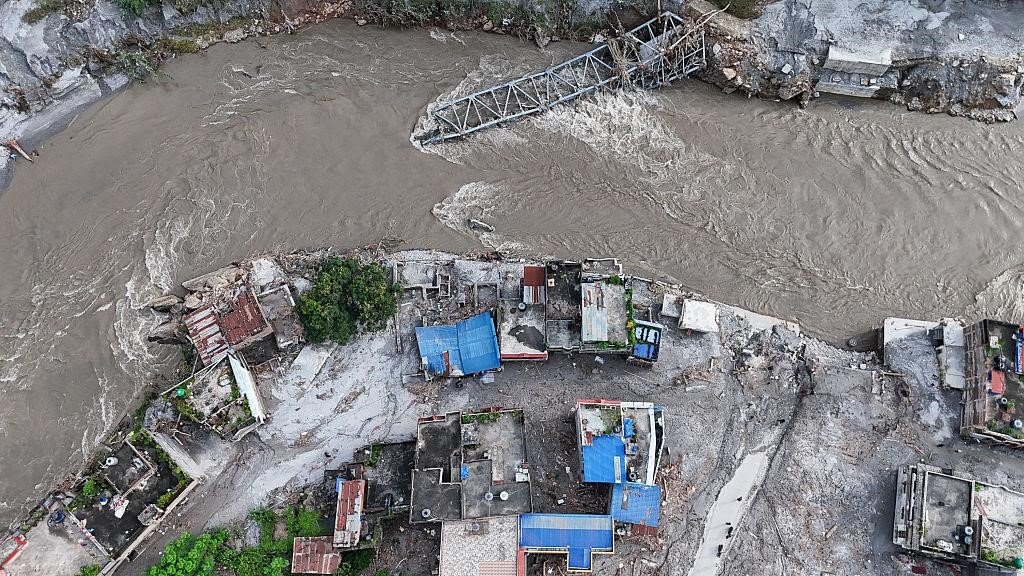
Nepal is facing one of the deadliest natural disasters in its recent history. A catastrophic flood triggered by a glacier collapse near the Nepal–China border has killed more than 1,200 people, while over 4,200 people remain missing, according to the latest reports.


The disaster struck on August 26, when a massive flow of ice, rock, mud and water swept through settlements in Nepal’s border region. Roads, bridges, homes and hydropower facilities were destroyed within hours.
More than a week later, rescue teams are still searching for survivors, particularly in remote areas and inside hydropower project tunnels.
Latest update: Reuters reported on September 3 that at least 1,204 people had been killed and more than 4,200 remained missing.
What Happened in Nepal?
The disaster began on August 26 in the Himalayan region close to the Nepal–China border.
A section of glacier and surrounding ice and rock collapsed into a mountain river. The resulting torrent carried enormous quantities of water, ice, mud and rocks downstream.
Instead of behaving like an ordinary river flood, the event became a powerful debris flow capable of destroying buildings and infrastructure in its path.
The flood devastated parts of Nepal’s Rasuwa district and also affected the border area around Tibet.
Reuters reported that the disaster generated an estimated 2.2 million tons of debris, making rescue and reconstruction extremely difficult.
Nepal Flood Death Toll Has Crossed 1,200
The death toll has risen rapidly as rescue teams reach previously inaccessible areas.
According to the latest Reuters reporting, 1,204 people have died, while more than 4,200 people remain unaccounted for.
However, these numbers should not necessarily be considered final.
Some remote communities remain difficult to reach, while identification of recovered bodies is also taking time. The number of missing people may change as authorities establish contact with isolated communities and compare missing-person records.
This is why the final scale of the disaster may not be known for some time.
Why Are Thousands of People Still Missing?

There are several reasons why thousands of people remain missing.
1. Entire Settlements Were Swept Away
The flood was carrying not only water but also huge quantities of rock, mud and ice.
In some locations, houses were completely washed away or buried beneath debris.
Nepal’s disaster authorities estimate that around 7,500 homes were completely destroyed, while approximately 20,000 homes may need to be rebuilt because many surviving structures are no longer safe to live in.
When entire settlements disappear, locating individuals becomes extremely difficult.
2. Roads and Bridges Were Destroyed
The flood destroyed or damaged roads and bridges connecting remote communities.
This has made it difficult for rescue teams, medical workers and heavy machinery to reach affected areas.
Helicopters and temporary bridges have therefore become essential parts of the rescue operation.
3. Communication Networks Were Disrupted
Power and communications were also damaged.
When mobile networks and electricity fail, families may have no way to contact relatives, while authorities cannot immediately determine who has survived.
4. Many People Were in Remote Areas
The affected Himalayan region is extremely mountainous.
Some people were travelling, working at hydropower projects or staying in isolated settlements when the flood struck.
The geography itself has become one of the biggest obstacles for rescuers.
Hydropower Tunnels Have Become a Major Rescue Challenge
One of the most difficult parts of the operation is searching hydropower projects.
Hundreds of workers were believed to have been inside or around hydropower facilities when the disaster occurred.
Earlier assessments indicated that hundreds of people remained unaccounted for at hydropower sites. Rescue teams have been using excavators and other heavy machinery to clear massive quantities of mud and debris.
At the Rasuwagadhi hydropower plant, officials have said that dozens of workers may still be trapped inside a tunnel-like chamber.
One report said 46 workers were believed to remain trapped, with officials hopeful that some could still be alive because they may have access to food and water.
This has kept hopes alive that more survivors could still be found.
Could Missing People Still Be Alive?
There is still some hope, particularly for people trapped in protected structures such as tunnels.
A person trapped underground can potentially survive longer than someone exposed directly to floodwater, depending on access to air, drinking water, food and shelter.
This is why rescue teams are continuing to search hydropower tunnels despite the difficult conditions.
However, the chances of finding survivors generally decrease as more time passes.
The rescue operation is therefore a race against time.
Nepal’s “Wall of the Missing”
One of the most emotional scenes following the disaster has emerged in Kathmandu.
Families searching for relatives have gathered around a wall displaying photographs and information about missing people.
Reuters described it as a “Wall of the Missing”, where photographs, names and contact information are being displayed in the hope that someone can provide information about those who disappeared.
For families, the wall has become both a place of grief and a symbol of hope.
Some relatives are still waiting for confirmation about whether their loved ones survived.
Why Is Identifying the Dead Also Difficult?
Finding victims is only one part of the problem.
Identifying recovered bodies can be extremely difficult after a disaster involving fast-moving water, mud and debris.
Some victims may have been separated from their families by many kilometres.
Authorities and international teams are therefore using forensic techniques, including DNA testing, to help identify victims.
This process can take time, especially when large numbers of people are missing simultaneously.
India and Other Countries Are Helping Nepal

Nepal’s rescue operation has received international assistance.
Teams and support from India, China, South Korea and other countries have contributed to rescue, technical and humanitarian efforts.
India has provided specialised assistance, including support for rescue operations and forensic work.
International cooperation is particularly important because Nepal needs specialised equipment, heavy machinery, technical expertise and medical assistance to reach some of the most severely affected areas.
Nepal Faces a Huge Reconstruction Challenge
The immediate priority is finding survivors and helping displaced families.
But once the rescue operation slows, Nepal will face another enormous challenge: rebuilding.
The disaster has damaged:
- Homes
- Roads
- Bridges
- Hydropower projects
- Electricity infrastructure
- Communication networks
- Schools
- Local businesses
- Border infrastructure
Nepal’s authorities estimate that around 20,000 homes may need to be rebuilt.
The cost of reconstruction could therefore be enormous.
Earlier estimates put Nepal’s total recovery and rebuilding requirement at around $4–5 billion, although the final figure will depend on detailed damage assessments.
Is Climate Change Making Himalayan Floods More Dangerous?
The disaster has also raised questions about the increasing risks facing the Himalayan region.
Scientists have warned that warming temperatures are contributing to changes in glaciers, snow and mountain environments.
When glaciers become unstable, sudden collapses can potentially trigger devastating floods and debris flows.
Reuters reported that scientists have linked recent warming and glacier instability to the broader risks facing Himalayan communities.
However, it is important not to claim that climate change alone caused this specific disaster. The exact combination of geological, glacial and weather-related factors requires scientific investigation.
Nepal Plans Better Early-Warning Systems
The disaster has also highlighted the importance of early-warning technology.
Nepal is considering rebuilding and strengthening monitoring systems along vulnerable areas near the China border.
Proposed technology includes:
- Seismic sensors
- Cameras
- Satellite connectivity
- Real-time monitoring
- Early flood warnings
The objective is to provide downstream communities with even a few minutes of warning when dangerous landslides or glacial events occur.
Even a short warning could potentially save lives by allowing people to move to higher ground.
What Happens Next?
Nepal’s response will likely move through three major stages.
Phase 1: Search and Rescue
The immediate focus remains on locating survivors and people trapped in tunnels or isolated areas.
Phase 2: Relief and Rehabilitation
Displaced families need:
- Food
- Clean drinking water
- Medicine
- Temporary shelters
- Sanitation facilities
- Electricity
- Communication services
Phase 3: Reconstruction
The government will eventually have to rebuild homes, roads, bridges and other infrastructure.
At the same time, authorities will have to consider whether some communities should be relocated to safer areas rather than rebuilt in locations vulnerable to future disasters.
Final Thoughts
Nepal’s devastating flood has developed into a major humanitarian crisis.
With at least 1,204 people confirmed dead and more than 4,200 still missing, thousands of families are waiting for answers.
The continuing search inside hydropower tunnels offers some hope of finding additional survivors, while rescue teams are also working to reach remote communities cut off by destroyed roads and bridges.
But the crisis will not end when the last rescue operation finishes.
Nepal will then face the enormous task of rebuilding thousands of homes and damaged infrastructure while preparing for the possibility of similar disasters in the future.
The tragedy is a reminder of how vulnerable Himalayan communities can be when extreme natural events combine with difficult terrain and fragile infrastructure.
BharatPedia will continue to update this story as Nepal’s authorities release new information about the death toll, missing people and rescue operations.
About the Author