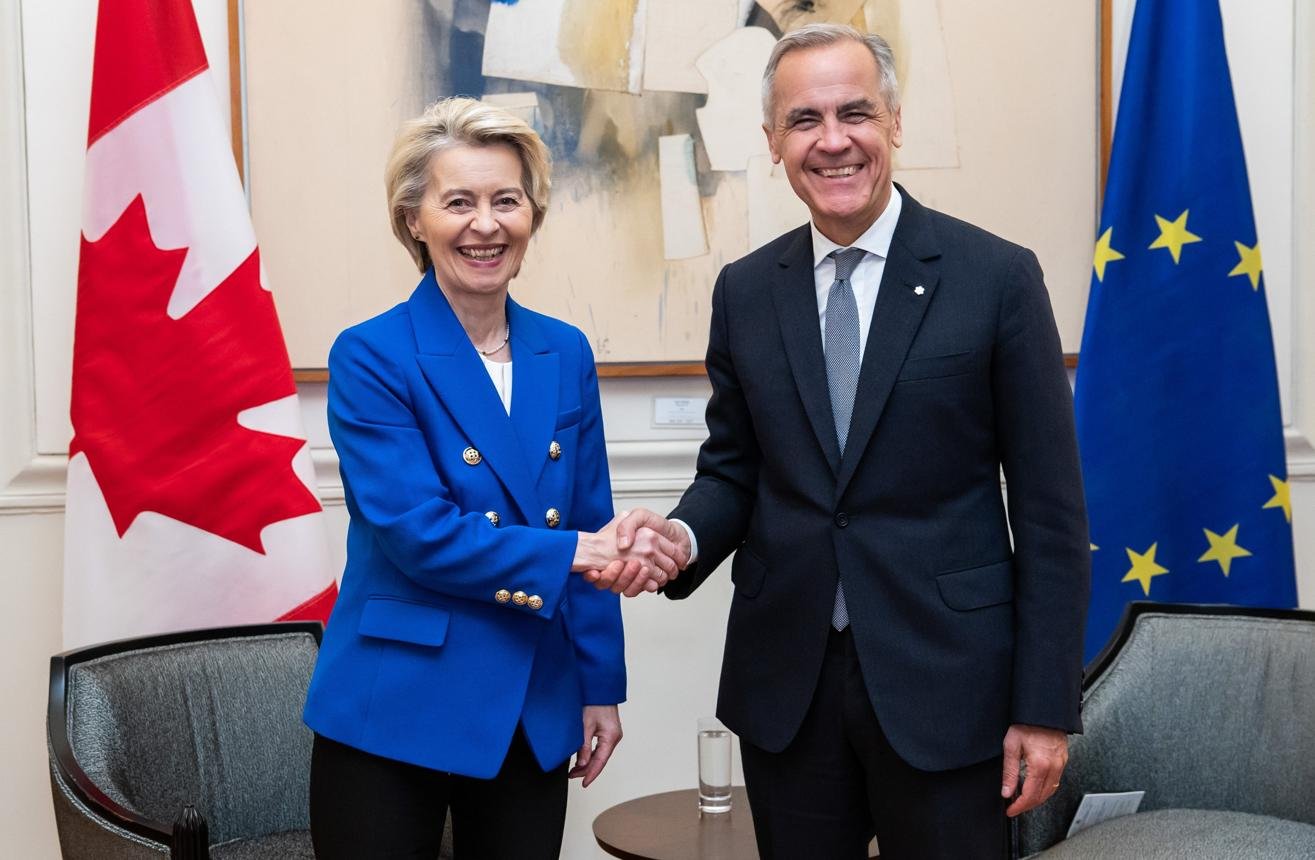
Canada and the European Union are moving toward closer cooperation, but there is still no guarantee that Canada will become the European Union’s first “associate member.”
Canadian Prime Minister Mark Carney welcomed the idea during his address to the European Parliament in Strasbourg on Thursday, September 17, after European Commission President Ursula von der Leyen proposed creating a new form of relationship with Canada.
Carney expressed strong support for deeper ties with Europe but stopped short of formally committing Canada to the specific “associate member” label. He also stressed that Canada is not seeking full EU membership.


Canada Welcomes Closer Ties With Europe
Speaking to European lawmakers, Carney described Canada and Europe as natural partners and called for deeper cooperation across several strategic areas.
His vision includes closer collaboration on defence, energy security, critical minerals, artificial intelligence, technology, digital trade and economic security.
Canada already has a major trade relationship with the EU through the Comprehensive Economic and Trade Agreement, commonly known as CETA. The proposed new relationship would seek to expand cooperation beyond traditional trade.
Carney said the precise name of the arrangement was ultimately a matter for Europe, emphasizing that the substance of the relationship would be more important than its terminology.
What Is EU Associate Membership?
One of the biggest questions surrounding the proposal is what “associate membership” would actually mean.
The term does not currently exist as a formal membership category in the EU treaties. No country has previously held this exact status.
Von der Leyen proposed the idea as a way to build a deeper strategic relationship between Canada and the EU without making Canada a full member of the bloc.
Possible areas of closer cooperation could include trade, defence, research, energy, technology and critical raw materials.
However, the exact legal structure and rights of such a relationship would have to be negotiated.
Canada Is Not Seeking Full EU Membership
Carney made an important distinction during his European Parliament speech.
Canada is not seeking to become a full member of the European Union.
Instead, Ottawa is interested in developing what it describes as a deeper strategic alliance with European countries while maintaining Canadian sovereignty.
The proposal therefore represents a potential new model of cooperation rather than an application by Canada to join the EU as a conventional member state.
That distinction matters because EU membership would involve a much deeper level of political and economic integration.
No Guarantee the Proposal Will Become Reality
Despite the positive language from European and Canadian leaders, the proposal remains at an early stage.
EU member states have not formally approved a new “associate membership” category, and there is no established procedure guaranteeing that the proposal will move forward.
European officials have indicated support for closer ties with Canada, but some governments have also expressed caution about the terminology and the practical details of the arrangement.
The proposal would therefore require further discussions among EU institutions and member states before any formal agreement could be reached.
Trade and Economic Security Are Key Areas
Economic cooperation is expected to be one of the major components of any future Canada-EU arrangement.
Canada and the EU already have CETA, which provides a framework for trade and investment. But both sides are now looking at areas such as critical minerals, energy security, technology and supply-chain resilience.
Critical minerals are particularly important because Canada has significant natural resources that are important for batteries, advanced manufacturing and clean-energy technologies.
Closer cooperation could help Canada and European countries diversify their supply chains and reduce dependence on a smaller number of global suppliers.
Defence and Security Could Also Become More Important
Defence cooperation is another major area being discussed.
Canada and European countries already cooperate through NATO, but the proposed relationship could provide additional opportunities for cooperation on defence industries, Arctic security, energy infrastructure and emerging technologies.
Carney has presented closer ties with Europe as part of a broader effort to strengthen Canada’s international partnerships. The Canadian government has said that European countries are natural partners because of shared interests, history and security concerns.
Proposal Comes Amid Tensions With the United States
The EU-Canada discussion is also taking place during a period of significant uncertainty in North American and transatlantic trade relations.
U.S. President Donald Trump has criticized the proposed arrangement and warned that the United States could impose tariffs on Europe if the EU moves ahead with the plan.
Trump has also described the proposal as “laughable,” while Canadian officials have emphasized Canada’s right to develop international partnerships.
Carney has said that closer Canada-EU relations are a positive initiative rather than an arrangement directed against another country.
What Happens Next?
The next stage is likely to involve negotiations over what a deeper Canada-EU partnership could actually look like.
Questions include:
- What legal status would Canada receive?
- Which EU programmes could Canada participate in?
- How much additional market access would be provided?
- Would there be new defence commitments?
- How would critical-mineral and energy cooperation work?
- What approval would be required from EU member states?
- What role would Canada’s Parliament have?
Carney has indicated that Canada’s Parliament would debate and vote on the future relationship.
Conclusion
Canada has responded warmly to the European Union’s unprecedented proposal for an “associate membership” relationship, but the idea is still far from being a completed agreement.
Mark Carney has welcomed the ambition for deeper cooperation while making clear that Canada is not seeking full EU membership.
For now, the proposal remains a diplomatic and political initiative that will require negotiations, legal work and approval from the relevant European and Canadian institutions.
The coming months should provide a clearer picture of whether the idea develops into a formal new partnership between Canada and the European Union
About the Author