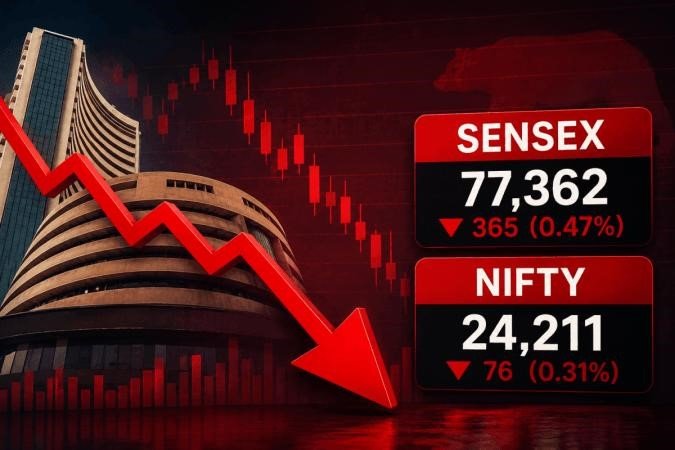


Indian stock markets came under fresh pressure on Friday as rising crude oil prices and escalating geopolitical tensions in the Middle East triggered a broad-based sell-off.
The Nifty 50 fell 0.92% to 23,261.70, while the BSE Sensex declined 0.84% to 74,272.61, according to Reuters. Both benchmarks closed at around three-month lows.
The biggest concern for investors was the sharp rise in crude oil prices. Brent crude moved above $108 per barrel, raising fears that a prolonged energy shock could increase India’s import bill, inflation and pressure on corporate profit margins.
Why Did Sensex and Nifty Fall Today?
The market decline was not caused by a single factor. Several concerns came together at the same time.
1. Crude Oil Surges Above $108
The biggest trigger was crude oil.
Brent crude rose sharply as Middle East tensions threatened important shipping and oil-supply routes. Oil had earlier moved close to $110 before retreating later in the session.
For India, expensive crude is particularly important because the country imports a large portion of its crude oil requirements.
Higher crude can mean:
- Higher import costs
- Pressure on the rupee
- Higher transportation costs
- Higher inflation
- Pressure on company margins
- Greater pressure on India’s current account
This is why a sustained rise in oil prices can become negative for Indian equities.
2. Middle East Tensions Increase Supply Concerns
The latest market sell-off came amid worsening geopolitical tensions in the Middle East.
According to Reuters, Iran-aligned Houthi forces captured Yemen’s port city of Mocha and advanced along Red Sea routes, increasing concerns about disruptions to shipping.
The Strait of Hormuz and Red Sea are strategically important for global energy transportation.
If shipping disruptions continue, investors could see another period of elevated crude prices.
3. Inflation Fears Are Back
Higher crude oil prices can make inflation more difficult to control.
For India, expensive oil can affect the cost of transportation, logistics, manufacturing and several consumer products.
This creates a difficult situation for policymakers: if inflation remains high for longer, interest rates may not fall as quickly as investors expect.
That is negative for interest-rate-sensitive sectors such as banks, automobiles, real estate and consumer businesses.
4. Bond Yields Also Rise
Indian government bond yields also moved higher.
Reuters reported that India’s benchmark 10-year government bond yield crossed 7%, reaching its highest level in more than three months.
Higher bond yields can make fixed-income investments relatively more attractive compared with equities.
They can also increase borrowing costs across the economy.
This creates another headwind for stock valuations.
5. Rupee Under Pressure
The Indian rupee also faced pressure as oil prices climbed.
Reuters reported that the rupee fell as much as 0.4% to ₹95.7925 per US dollar before recovering to around ₹95.71. Traders also reported that state-run banks appeared to be selling dollars, likely as part of RBI intervention.
A weaker rupee can make imported crude oil more expensive in rupee terms.
That can create a negative cycle:
Higher crude → higher dollar demand → weaker rupee → more expensive imports → inflation pressure
Which Sectors Were Hit the Most?
The selling was broad-based.
Reuters reported that 15 of 16 major sectoral indices declined. Financial stocks fell about 1.4%, metals dropped 2.8% and automobile stocks declined 1.3%. Small-cap and mid-cap stocks also fell more sharply, by around 1.2% and 1.4%, respectively.
Metals
Metal stocks were among the biggest losers, with the sector falling around 2.8%.
Investors are concerned that higher energy costs and weaker global growth could hurt industrial demand and margins.
Automobile Stocks
Auto stocks also came under pressure.
Higher crude prices can affect fuel costs and consumer sentiment, while a weaker rupee can increase the cost of imported components and commodities.
Financial Stocks
Financial stocks declined as rising bond yields and concerns about inflation and interest rates weighed on sentiment.
Are Any Stocks Benefiting From Higher Crude?
Interestingly, not every stock was falling.
Oil producers such as ONGC and Oil India managed modest gains as higher crude prices can improve the earnings environment for upstream energy companies.
This creates an important distinction for investors:
Higher crude is generally negative for oil-importing companies but can be positive for some upstream oil producers.
However, the actual impact depends on government policy, crude realisations, taxes, subsidies and company-specific factors.
What Does $108 Oil Mean for India?
If Brent crude remains around $100–$110 for an extended period, India could face several economic challenges.
Possible effects:
Inflation:
Higher fuel and transportation costs can put upward pressure on prices.
Rupee:
India’s crude import bill can rise, increasing demand for US dollars.
Corporate margins:
Companies that cannot pass higher input costs to customers could see margins squeezed.
Interest rates:
Persistent inflation could make monetary easing more difficult.
Consumer spending:
Higher fuel and household expenses can reduce disposable income.
Stock valuations:
Higher yields and weaker earnings expectations can put pressure on equity valuations.
Will the Stock Market Fall Further?
That cannot be predicted with certainty.
The key factors investors will watch are:
- Brent crude prices
- Middle East developments
- Strait of Hormuz and Red Sea shipping
- Indian rupee movement
- RBI liquidity and monetary policy
- US Federal Reserve expectations
- Foreign investor flows
- Inflation data
- Corporate earnings
If crude prices cool significantly and geopolitical tensions ease, some of the pressure on equities could disappear.
But if oil remains above $100 for an extended period, investors may continue to remain cautious.
Sensex and Nifty: Weekly Performance
Friday’s decline was particularly important because both benchmarks were heading for their fifth consecutive weekly fall.
Reuters reported that for the week, the Nifty 50 was down about 2.7%, while the Sensex had declined around 2.9%.
That shows the current weakness is more than a one-day correction.
What Should Investors Do?
Investors should avoid making decisions purely because the Sensex or Nifty falls sharply in one session.
Instead, long-term investors can focus on:
- Company fundamentals
- Debt levels
- Cash flow
- ROCE/ROE
- Earnings growth
- Valuation
- Promoter holding
- Sector outlook
- Impact of crude oil on the particular business
Companies with strong balance sheets and pricing power may be better positioned to handle a temporary increase in input costs.
Short-term traders, however, should expect higher volatility while geopolitical tensions and crude prices remain elevated.
Final Verdict
The latest Sensex-Nifty decline is mainly a combination of geopolitical uncertainty, crude oil above $108, inflation fears, higher bond yields and rupee pressure.
For India, the biggest risk is not necessarily a one-day rise in crude but a sustained period of expensive oil.
If crude prices stabilise and Middle East tensions ease, Indian equities could recover some of their recent losses. But if oil remains elevated, investors may continue to face pressure from inflation, interest-rate expectations and weaker corporate margins.
For now, volatility is likely to remain high, and investors should focus on fundamentals rather than panic-selling solely because of a market decline.
This article is for news and educational purposes only and should not be considered investment advice.
About the Author