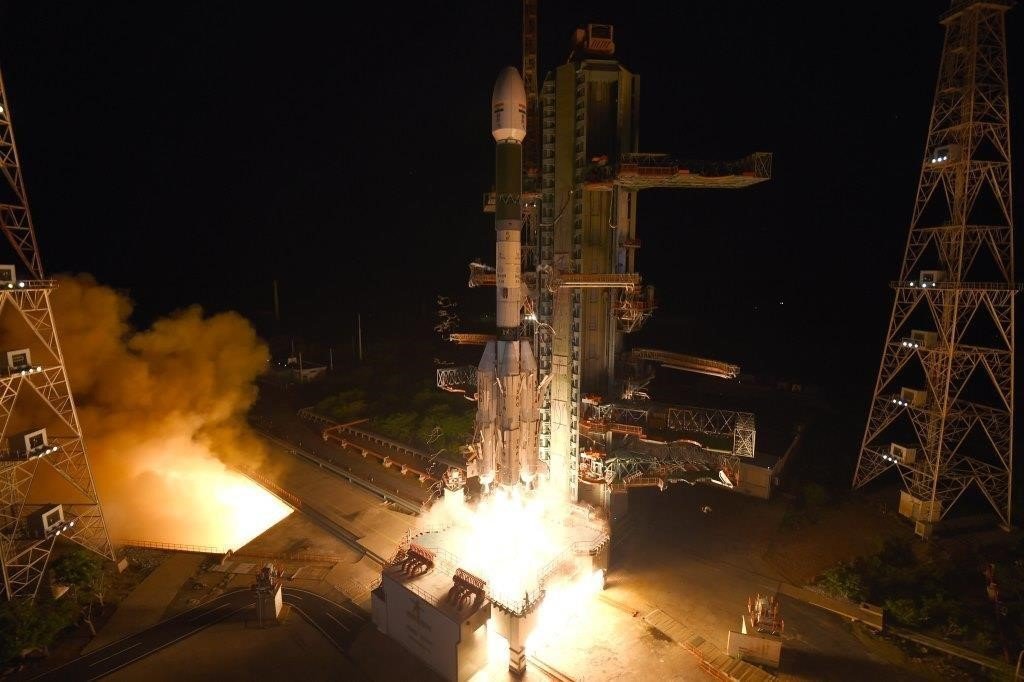


The satellite is scheduled to launch aboard the GSLV-F17 rocket on September 4, 2026, at 2:55 AM IST from the Second Launch Pad at the Satish Dhawan Space Centre in Sriharikota, Andhra Pradesh.
The mission is particularly significant because EOS-05 is designed to become India’s first Earth-observation imaging satellite operating from a geosynchronous orbit. From roughly 36,000 km above Earth, it will be able to repeatedly observe a large region rather than passing over it only occasionally like many low-Earth-orbit satellites.
What Is ISRO EOS-05?
EOS-05 is an advanced Earth observation satellite developed by ISRO.
It is also known as GISAT-1A, reflecting its connection with India’s Geo-Imaging Satellite programme.
According to ISRO, EOS-05 is a state-of-the-art Earth-observation spacecraft and will be India’s first imaging satellite operating from a geosynchronous orbit.
Its primary purpose is to provide frequently updated images of large areas, supporting applications such as:
- Disaster management
- Weather and environmental monitoring
- Agriculture
- Flood monitoring
- Forest and land monitoring
- Infrastructure planning
- Strategic observation
The satellite is expected to provide India with a much more persistent view of important areas.
When Will EOS-05 Launch?

ISRO has scheduled the mission for:
| Mission Detail | Information |
|---|---|
| Satellite | EOS-05 / GISAT-1A |
| Launch Vehicle | GSLV-F17 |
| Launch Date | September 4, 2026 |
| Launch Time | 2:55 AM IST |
| Launch Site | Satish Dhawan Space Centre, Sriharikota |
| Launch Pad | Second Launch Pad |
| Mission Type | Earth Observation |
| Target Orbit | Sub-Geosynchronous Transfer Orbit |
ISRO’s official mission page confirms that GSLV-F17 will initially place EOS-05 into a Sub-Geosynchronous Transfer Orbit (Sub-GTO).
Why Is EOS-05 So Important for India?
The biggest advantage of EOS-05 is its planned geosynchronous imaging capability.
Traditional Earth-observation satellites in low Earth orbit move around the planet and therefore observe a particular location only when they pass over it.
EOS-05 will operate much higher, allowing it to maintain a much more persistent view of a large region.
This could be particularly useful when India needs rapid information during emergencies.
How Can EOS-05 Help During Natural Disasters?


One of the most important applications of EOS-05 could be disaster management.
During floods, cyclones, landslides and major fires, authorities need updated information about what is happening on the ground.
Satellite imagery can help emergency agencies understand:
- Which areas are flooded
- Which roads are blocked
- Where infrastructure has been damaged
- How a disaster is spreading
- Which regions need urgent assistance
The ability to repeatedly observe a large region could make EOS-05 particularly useful for time-sensitive disaster response.
EOS-05 and Weather Monitoring
EOS-05 is not simply a conventional weather satellite, but its frequent Earth-imaging capability can provide valuable information for environmental monitoring.
Its observations could contribute to understanding changes in:
- Clouds
- Land surfaces
- Vegetation
- Water bodies
- Flooded areas
- Environmental conditions
This information can complement data from India’s dedicated meteorological satellites.
What Does “Geosynchronous Orbit” Mean?


A geosynchronous orbit is an orbit where a satellite’s orbital period matches Earth’s rotation period.
At approximately 36,000 km above Earth, a satellite can repeatedly observe the same broad region.
This is why geosynchronous satellites are extremely valuable for applications requiring frequent observations.
EOS-05 will initially be placed into a Sub-GTO by GSLV-F17. The spacecraft’s own propulsion system is then expected to help raise it toward its intended geosynchronous orbit.
EOS-05 Will Be Launched by GSLV-F17
The satellite will be carried by ISRO’s GSLV-F17 rocket.
GSLV, or Geosynchronous Satellite Launch Vehicle, is designed to place heavier spacecraft into higher orbits.
For this mission, the rocket will first place EOS-05 into the required transfer orbit before the satellite performs additional orbital manoeuvres.
This makes the launch vehicle an important part of the mission’s success.
How Heavy Is EOS-05?
EOS-05 is reported to have a mass of approximately 2,367 kg.
That makes it a substantial spacecraft for an Earth-observation mission and one that requires a powerful launch vehicle capable of delivering it toward geosynchronous orbit.
What Cameras and Sensors Does EOS-05 Use?
The GISAT family is designed around advanced imaging technology.
Reports describe EOS-05 as carrying multispectral and hyperspectral imaging capabilities designed to observe Earth across different wavelengths.
This allows scientists and agencies to extract information that may not be visible in ordinary photographs.
For example, different wavelengths can help distinguish vegetation, water, soil and other surface characteristics.
EOS-05 and India’s Security
Another potentially important application is strategic observation.
A satellite capable of frequently observing large regions could provide useful information for monitoring India’s borders and surrounding areas.
Several reports have highlighted its potential for persistent surveillance, particularly because of its high-altitude geosynchronous position.
However, the satellite’s publicly described role is broader than defence. Earth observation, disaster management and environmental monitoring are also major objectives.
EOS-05 Replaces an Earlier GISAT Mission
The EOS-05 mission is also significant because it follows the earlier GISAT-1/EOS-03 mission.
That spacecraft was lost after the GSLV-F10 launch experienced an upper-stage problem in August 2021.
EOS-05/GISAT-1A is intended to restore this important geostationary Earth-imaging capability.
Why Is This Mission Important for ISRO?
The EOS-05 mission comes after a period in which ISRO had not conducted a launch for around seven months.
The successful launch would therefore represent an important return to flight for the organisation.
More importantly, the mission would demonstrate India’s ability to place an advanced Earth-imaging spacecraft into a high geosynchronous orbit.
When and Where Can You Watch the Launch?
The launch is scheduled for 2:55 AM IST on September 4, 2026, from the Satish Dhawan Space Centre in Sriharikota.
ISRO generally provides official mission updates and launch coverage through its digital channels.
For readers, it is worth checking ISRO’s official website and official social-media channels shortly before launch for the confirmed live-stream information.
What Could EOS-05 Mean for Ordinary Indians?
Although a satellite thousands of kilometres above Earth may seem distant from everyday life, its data can have practical applications.
EOS-05 could contribute to better information for:
Farmers: Monitoring crops, vegetation and land conditions.
Disaster agencies: Tracking floods and other emergencies.
Scientists: Studying environmental changes.
Government planners: Monitoring infrastructure and land use.
Security agencies: Supporting large-area observation.
The real benefit will come from how quickly and effectively the satellite’s data can be converted into useful information.
Final Verdict: A Major Step for India’s Earth Observation Capability
EOS-05 is much more than another satellite launch.
If the September 4 mission succeeds, India will gain a new Earth-observation capability based in geosynchronous orbit, allowing more persistent imaging of large areas.
Its potential applications range from disaster management and agriculture to environmental monitoring and strategic observation.
For ISRO, the GSLV-F17/EOS-05 mission is also an important technological milestone and a significant return to launch activity after a seven-month pause.
With liftoff scheduled for 2:55 AM IST on September 4, all eyes will be on Sriharikota as India prepares to send its new “eye in the sky” into space.
About the Author