

India has one of the world’s largest known thorium resources, making the radioactive element an important part of the country’s long-term nuclear-energy strategy. Claims circulating online sometimes suggest that India’s thorium reserves could provide enough fuel to power the country for hundreds of years.
The broader idea has a basis in India’s nuclear programme, but the “400 years” figure should be treated as an estimate rather than a guaranteed forecast. The actual amount of electricity that could ultimately be produced depends on reactor technology, fuel-cycle efficiency, the amount of thorium that can be economically recovered and converted into usable fuel, and India’s future electricity demand.
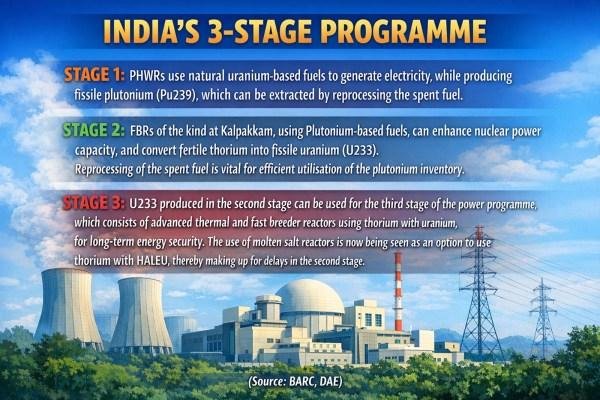
India’s Department of Atomic Energy (DAE) has been working for decades toward the large-scale utilisation of thorium through its three-stage nuclear power programme.
How Much Thorium Does India Have?
India has significant thorium-bearing mineral resources, particularly in monazite deposits.
A government record from the Atomic Minerals Directorate for Exploration and Research reported 11.93 million tonnes of in-situ monazite resources containing about 1.07 million tonnes of thorium as of September 2014. The resources were identified across several states, including Odisha, Andhra Pradesh, Tamil Nadu, Kerala, West Bengal and Jharkhand.
This is why India is frequently described as having abundant thorium resources.
However, it is important to understand the difference between thorium resources and usable nuclear fuel. A large quantity of thorium in the ground does not automatically translate into an equivalent quantity of electricity-producing reactor fuel.
Why Is Thorium Important for India?
India has relatively limited domestic uranium resources compared with its thorium resources. The country’s nuclear programme was therefore designed around a long-term strategy to make greater use of thorium.
The DAE’s three-stage programme starts with natural uranium-fuelled Pressurised Heavy Water Reactors (PHWRs). The second stage uses plutonium in Fast Breeder Reactors, while the third stage is intended to make large-scale use of thorium through the production and utilisation of Uranium-233.
This strategy is intended to help India build a more self-reliant nuclear fuel cycle.
Thorium Cannot Simply Be Put Into a Reactor
One of the most important facts often missed in online discussions about India’s thorium reserves is that Thorium-232 cannot simply be used by itself as conventional reactor fuel.
According to the Department of Atomic Energy, thorium is a fertile material rather than a fissile fuel. It needs to be converted inside a reactor into Uranium-233, which can then be used as nuclear fuel.
This conversion is a major part of India’s long-term thorium strategy.
In simple terms:
Thorium-232 → Reactor process → Uranium-233 → Nuclear fuel → Electricity
This is why India’s thorium programme requires advanced reactors and a closed nuclear fuel cycle rather than simply mining thorium and putting it directly into existing nuclear power plants.
What Does the “400 Years of Power” Claim Mean?
The idea that India’s thorium could power the country for around 400 years is best understood as a theoretical or scenario-based estimate, not as a government guarantee.
The number depends on assumptions about India’s electricity consumption, reactor efficiency, the amount of thorium that can actually be utilised and future nuclear technology.
India’s government has previously described thorium as a potential long-term energy resource that could be used for centuries. However, the government has also explicitly noted that thorium cannot solve India’s short-term power requirements because the necessary fuel cycle and reactor technology have to be developed.
Therefore, headlines claiming that “500,000 tonnes of thorium will definitely power India for 400 years” can oversimplify the science.
India Has Made Progress Toward Thorium Utilisation
India’s thorium programme has moved beyond basic research.
In April 2026, India’s Prototype Fast Breeder Reactor (PFBR) at Kalpakkam achieved first criticality. The milestone marked the beginning of the second stage of India’s three-stage nuclear programme and is important for the country’s long-term plan to utilise thorium.
The DAE has also conducted research involving thorium oxide and thorium-based fuels. Irradiated thorium fuel has been processed to obtain Uranium-233, which has been used to fabricate fuel for the KAMINI research reactor at Kalpakkam.
These activities demonstrate that India has developed practical expertise in parts of the thorium fuel cycle.
Thorium-Based Power Is Still a Long-Term Goal
Despite the country’s progress, commercial large-scale thorium power is not yet a reality.
The government stated in March 2026 that molten-salt reactor technology is one of the technologies being considered for thorium utilisation, but also acknowledged that the technology is not yet mature and that its economic implications would need to be assessed after limited-scale demonstration.
This means India’s thorium story is more about future energy security than an immediate replacement for coal, gas or conventional nuclear power.
Why Thorium Could Be Important for India’s Energy Future
If India successfully develops an efficient and economically viable thorium fuel cycle, the country’s large domestic thorium resources could provide an additional source of nuclear fuel.
The potential advantages include reducing dependence on imported nuclear fuel and supporting long-term energy security.
India’s current nuclear strategy aims to expand nuclear power significantly. The government has outlined a roadmap toward approximately 100 GW of nuclear capacity by 2047, while continuing work on the three-stage programme.
Thorium could eventually become an important part of that long-term strategy.
The Big Challenge: Technology
The biggest question is not whether India has thorium.
India clearly has substantial thorium resources.
The bigger challenge is developing the technology and infrastructure needed to convert those resources into reliable, economical electricity at a large scale.
This includes advanced reactors, fuel fabrication, reprocessing, safety systems and a mature closed fuel cycle.
A recent government parliamentary report also noted that India’s transition to thorium-based fuel cycles remains at an early stage and that significant technological and infrastructure challenges still need to be addressed.
Final Takeaway
India’s thorium reserves are genuinely significant and form an important part of the country’s long-term nuclear-energy strategy. Government data has previously estimated more than 1 million tonnes of thorium resources, although the exact figure depends on how resources are classified and updated.
The claim that India’s thorium could power the country for 400 years should not be presented as a guaranteed outcome. It is better understood as a long-term theoretical estimate that depends heavily on future technology, reactor efficiency, fuel-cycle development and electricity demand.
What is clear is that India is continuing to develop the technology needed to eventually utilise thorium on a much larger scale. The 2026 PFBR milestone has brought the country another step closer to the second stage of its three-stage nuclear programme, which is intended to support eventual large-scale thorium utilisation
About the Author