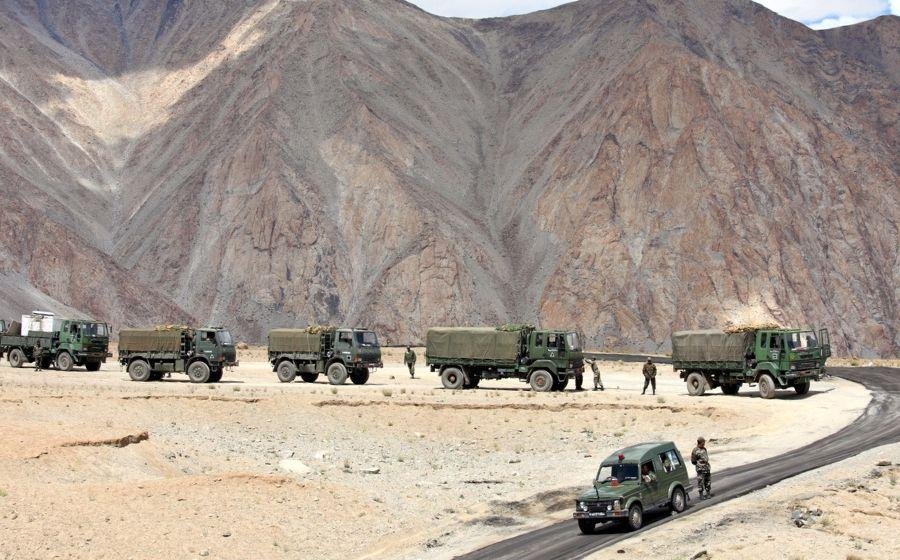
India has reported a significant reduction in China’s military deployment along the Line of Actual Control (LAC), marking another development in the gradual easing of tensions between the two Asian neighbours. According to India’s Defence Ministry annual report for 2025–26, the People’s Liberation Army (PLA) reduced its deployment along India’s northern borders during 2025.


The report said that China continued to maintain around 10 combined-arms brigade-sized forces in areas along the LAC and in traditional training zones. While the overall deployment has declined, Indian officials have stressed that the border remains strategically sensitive and that Indian forces continue to maintain a strong posture.
China Reduces PLA Deployment Along the LAC
The latest assessment comes from India’s Ministry of Defence and covers developments during 2025.
The report described a “significant reduction” in the deployment of PLA forces opposite India’s northern borders. It also linked improved stability along the border to political, diplomatic and military engagement between the two countries.
However, the reduction does not mean that China has completely withdrawn its military forces from the region.
Around 10 combined-arms brigade-sized formations remain deployed in areas close to the LAC and in traditional training areas. A combined-arms brigade is generally estimated by analysts to contain several thousand personnel, meaning a substantial Chinese military presence remains in the region.
India Maintains Strong Military Presence
While China has reduced some of its deployment, India has said that its own military posture along the LAC remains robust.
The Defence Ministry report stated that Indian Army deployment across sectors of the LAC remains well-positioned and prepared to respond to emerging contingencies. This indicates that troop reductions on the Chinese side have not resulted in India abandoning its security preparations.
India has also continued developing roads, tunnels and other infrastructure along the Himalayan border. These projects are intended to improve the movement of troops, equipment and supplies in difficult high-altitude terrain.
Why the LAC Remains Important
The India-China border is not fully demarcated, and the two countries have different perceptions of parts of the Line of Actual Control.
The border tensions became particularly serious after the 2020 Galwan Valley clash, when soldiers from both countries were killed. Following the confrontation, both India and China significantly increased military deployments in the Himalayan region.
The buildup resulted in tens of thousands of soldiers being positioned along sensitive sections of the border.
Since then, military and diplomatic negotiations have played an important role in reducing tensions.
2024 Agreement Helped Reduce Tensions
A major turning point came in October 2024, when India and China reached an agreement concerning patrolling arrangements in eastern Ladakh.
The agreement was followed by disengagement and a reduction in tensions at several friction points. Reuters reported that the two sides completed troop withdrawals from the relevant areas by December 2024, helping create conditions for a gradual improvement in bilateral relations.
The latest reduction in Chinese deployment during 2025 is therefore being viewed in the context of this broader diplomatic and military engagement.
However, the reduction in troop numbers should not be interpreted as the complete resolution of the India-China border dispute.
Military Dialogue Has Continued
Military communication between the two countries has also continued.
India and China have used Corps Commander-level meetings and Border Personnel Meetings to discuss issues along the LAC. An India-China Corps Commander-level meeting was also held in Arunachal Pradesh in September 2026 amid reports of tensions in the Taksing area.
These mechanisms are important because local incidents along the LAC can potentially create larger diplomatic problems if they are not handled through established communication channels.
The continuation of these meetings suggests that both sides continue to rely on dialogue to manage border-related issues.
Modi-Xi Talks and Improving Relations
The latest development also comes as India-China diplomatic relations show signs of cautious improvement.
Chinese President Xi Jinping visited New Delhi for the 2026 BRICS summit, marking his first visit to India in seven years. Prime Minister Narendra Modi and Xi held bilateral discussions during the summit.
According to reports, both leaders stressed the importance of maintaining peace and stability along the border and continuing dialogue over the boundary question.
The two countries have also gradually resumed several forms of engagement, including air connectivity, visas and the Kailash Mansarovar pilgrimage.
At the same time, major differences remain unresolved, particularly over the boundary and other strategic issues.
Does the Troop Reduction Mean the Border Dispute Is Over?
No.
A reduction in military deployment is an important development, but it does not settle the underlying territorial dispute.
China continues to maintain military infrastructure and forces near the border, while India has also strengthened infrastructure and maintained military preparedness.
Recent analysis has highlighted that both countries continue to view border security as a major strategic priority even while military tensions have declined.
Therefore, the current situation can be described as reduced military tension rather than a final resolution of the border dispute.
What Could Happen Next?
The future of India-China border relations will depend on continued military and diplomatic communication.
If both countries maintain existing agreements, continue commander-level talks and avoid new confrontations, the reduction in troop deployment could support further stabilization.
However, the disputed nature of the Himalayan border means that local incidents can still create tensions.
For India, maintaining infrastructure and military readiness remains important even as Chinese troop numbers decline. For China, the continued presence of substantial forces and infrastructure indicates that Beijing also continues to attach strategic importance to the region.
Final Takeaway
India’s latest Defence Ministry assessment indicates that China significantly reduced its PLA deployment along the northern borders during 2025, while retaining around 10 combined-arms brigade-sized formations in areas along the LAC and traditional training zones.
The development comes after years of heightened tensions following the 2020 Galwan clash and subsequent diplomatic and military negotiations. While the reduction represents a change in the military posture, the India-China boundary dispute remains unresolved.
For now, both countries appear to be combining military preparedness with diplomatic engagement as they attempt to manage one of Asia’s most sensitive borders.
About the Author