India BRICS 2026: Fourteen years ago, when India hosted the BRICS summit in New Delhi, the country was facing a very different economic environment. Growth concerns, high inflation, infrastructure bottlenecks and external vulnerabilities shaped the conversation around India’s position among the emerging economies.
Fast-forward to 2026, and the picture has changed dramatically.
India is now hosting BRICS again, but this time it enters the summit with a much larger economy, stronger digital infrastructure, rising private investment and a growing role in global supply chains. India has also taken over the BRICS chairship for 2026, making the New Delhi summit an important moment for the country’s economic and diplomatic influence.


From BRIC to a Much Larger BRICS
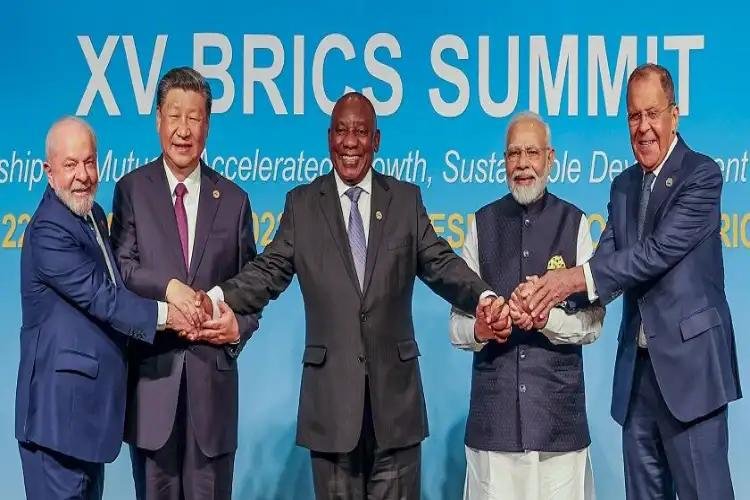
The BRIC grouping originally consisted of Brazil, Russia, India and China. South Africa joined in 2011, turning BRIC into BRICS.
Since then, the grouping has expanded significantly. Egypt, Ethiopia, Iran and the UAE joined in 2024, while Indonesia became a member in 2025. BRICS now has 11 members, giving the grouping a much larger economic and demographic footprint.
The expanded BRICS represents around half of the world’s population and roughly 40% of global GDP, according to recent statements and official material.
This expansion has also changed India’s position within the group.
What Was Different About India in 2012?
The 2012 BRICS summit took place against the backdrop of the global financial crisis and concerns about slowing growth.
At that time, India was dealing with high inflation, a large current-account deficit and concerns over policy bottlenecks. The country was still seen primarily as an emerging-market growth story rather than an economic heavyweight.
India was also significantly smaller in economic terms than it is today.
The 2012 summit nevertheless marked an important stage in India’s BRICS journey. The New Delhi declaration pushed for greater cooperation among the member countries, including increased use of local currencies in trade and stronger financial cooperation.
India’s Economic Transformation
The biggest change over the past 14 years has been the scale and structure of India’s economy.
India has moved from being primarily viewed as a high-potential emerging economy to becoming one of the world’s major economic growth engines.
Recent data shows that India’s economy grew 7.8% year-on-year in the April-June 2026 quarter, beating expectations and extending a run of strong quarterly growth. More importantly, private-sector investment has begun to strengthen alongside government infrastructure spending.
Private investment rose 11.9% year-on-year during the April-June quarter, while gross fixed capital formation increased substantially. Investments are expanding across areas such as railways, artificial intelligence, semiconductors, manufacturing and data centres.
That represents a significant shift from the concerns surrounding India’s growth model more than a decade ago.
Digital India Has Changed the Story
One of India’s biggest advantages today is its digital infrastructure.
The country’s digital-payment ecosystem, especially UPI, has become an important example of how technology can transform a large emerging economy.
This digital experience is increasingly relevant to BRICS discussions around cross-border payments and financial connectivity. BRICS members are exploring mechanisms that could make cross-border settlements easier and reduce dependence on traditional dollar-based banking channels.
For India, this creates an opportunity to present its digital public infrastructure experience as a potential model for other developing economies.
Infrastructure Is Becoming a Growth Multiplier
Infrastructure has also become one of the major pillars of India’s economic transformation.
Large investments in roads, railways, airports, ports, logistics networks and digital infrastructure have improved connectivity and created demand for manufacturing and services.
Recent economic data suggests that government infrastructure spending is now beginning to attract greater private-sector investment. Reuters reported that private capital expenditure increased significantly in 2026, indicating that infrastructure investment is increasingly creating conditions for broader economic expansion.
This is one reason India is increasingly being described as a growth engine rather than simply an emerging-market promise.
BRICS Is Also Becoming More Important for India
India’s relationship with BRICS is not only about economic growth.
New Delhi sees the grouping as a platform for strategic autonomy—working with emerging powers while maintaining strong relationships with Western economies.
This approach differs from the view of some BRICS members that want the bloc to become a stronger counterweight to the United States and Western institutions.
India has generally favoured a more balanced approach, seeking reforms in global institutions while avoiding turning BRICS into an explicitly anti-Western alliance.
The New Development Bank
One of BRICS’ most concrete achievements has been the creation of the New Development Bank (NDB).
Established in 2015, the bank was designed to finance infrastructure and sustainable-development projects in emerging economies. According to Reuters, the NDB has approved 139 projects worth nearly $43 billion.
For India, institutions such as the NDB provide another avenue for financing infrastructure and development projects outside traditional Western-led financial institutions.
India’s Role in the 2026 BRICS Presidency
India assumed the BRICS chairship on January 1, 2026.
The Indian presidency has focused on themes including resilience, innovation, cooperation and sustainability. India has also pushed discussions around technology, trade, startups, MSMEs, digital payments and institutional cooperation.
The timing is significant.
India is hosting BRICS at a moment when global trade is being reshaped by tariffs, geopolitical conflicts, energy disruptions and changing supply chains.
That gives New Delhi an opportunity to position itself as a bridge between different economic and geopolitical blocs.
India Is Not Without Challenges
Despite the transformation, India still faces significant challenges.
Per-capita income remains much lower than that of developed economies, while job creation, inequality, energy dependence and infrastructure gaps remain important issues.
Relations with China also remain complicated.
India and China have significant economic links but continue to face strategic disagreements, including concerns over trade imbalances and their broader geopolitical relationship. Recent diplomatic engagement has improved communication, but major differences remain.
The expansion of BRICS itself also creates challenges because the interests of 11 members are not always aligned.
From Weak Link to Growth Engine?
The transformation of India’s BRICS story over the past 14 years is therefore not simply about GDP.
It is about the country’s changing economic capabilities, digital infrastructure, investment environment and geopolitical relevance.
In 2012, India was largely discussed as an emerging economy with enormous potential but significant structural weaknesses.
In 2026, India is increasingly viewed as one of the key engines of growth within the expanded BRICS grouping.
Prime Minister Narendra Modi recently highlighted that BRICS countries now account for around 50% of global population, 40% of global GDP and more than 25% of global trade. He also said the combined GDP of BRICS has grown around 4.5 times since the grouping’s formation, nearly twice the pace of global GDP growth over the same period.
That does not mean India’s economic journey is complete. But it does show how dramatically the country’s position has changed.
Conclusion
India’s BRICS journey over the last 14 years reflects a broader transformation in the country’s economic and strategic position.
From concerns over inflation, infrastructure and external vulnerabilities in the early 2010s to strong growth, expanding private investment, digital innovation and greater global influence in 2026, India’s role within BRICS has evolved substantially.
The country is no longer simply participating in the growth story of emerging economies. It increasingly wants to help shape that growth story.
As India hosts the 2026 BRICS summit in New Delhi, the central question is no longer whether India can become a major growth engine.
The bigger question is how effectively India can use that economic weight to influence trade, technology, finance and global governance in the years ahead.
BharatPedia Takeaway: India’s transformation inside BRICS is a story of scale, technology, infrastructure and strategic autonomy—but the next phase will depend on whether strong GDP growth can translate into more jobs, higher productivity and broader prosperity.
About the Author